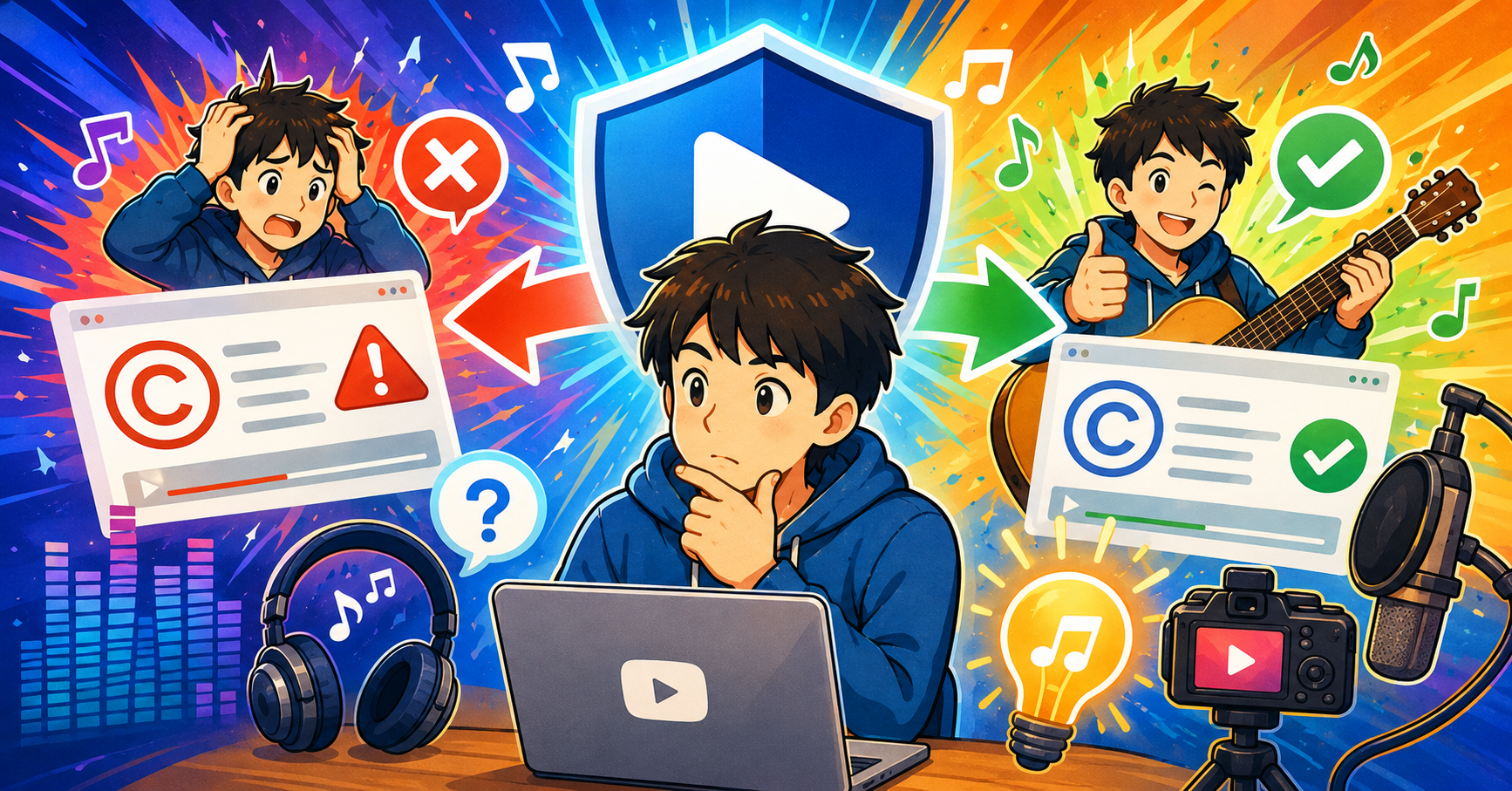
“I have a JASRAC license, so why did I get a copyright notice?!” “If I dispute this claim, will my channel be deleted?”
If you are a music creator or cover artist on YouTube, you have likely run into this frustrating scenario. However, most of the notifications you receive are not devastating “strikes” but rather automated “claims.” Don’t panic. By understanding how the system works, you can handle these notifications calmly and effectively.

1. First Things First: Understanding Claims vs. Strikes
YouTube sends two very different types of copyright notifications. Confusing them can lead to costly mistakes.
| Metric | Copyright Claim (Content ID) | Copyright Strike (Take-down) |
| Trigger | Automated detection via Content ID | Manual takedown request by the rightsholder |
| Primary Impact | Monetization is redirected to the rightsholder (or disabled) | Video is removed, and a penalty is applied to your channel |
| Urgency Level | Low (Review calmly; no immediate threat to your channel) | High (3 strikes result in a termination/BAN; immediate action required) |
| Current Trends | AI-driven false positives are rising due to synthetic audio/AI music tools | Issued against malicious re-uploads or clear terms of service violations |
The vast majority of notifications that cover artists and musicians encounter fall into the left column: Content ID Claims. These do not harm your channel’s standing or algorithmic reach.
2. Why Do Cover Videos Get Flagged Despite Blanket Licensing?
YouTube has blanket licensing agreements in Japan with major collective management organizations (CMOs) like JASRAC and NexTone. Yet, claims still happen due to three main factors:
① Automated Detection of Neighboring Rights (Master Rights)
YouTube’s Content ID system is highly sophisticated. Even if you perform or sing everything yourself from scratch, the underlying melodic structure or arrangement can trick the AI into flagging it as a match for the original record label’s sound recording rights (neighboring rights/master rights).

② False Positives by Foreign Rights Administrators
Even for purely Japanese tracks, overseas copyright organizations (such as ASCAP or BMI in the U.S.) or international sub-publishers and administrators may assert rights through the system. This occurs due to the global nature of matching systems, where local Japanese blanket agreements do not always perfectly sync with overseas automated enforcement data.
③ Automated Triggers from Segmented Copyright Administration
In recent years, many Japanese creators and rightsholders have adopted segmented management models—for instance, assigning performance rights to JASRAC while entrusting internet streaming (interactive distribution) rights to NexTone. Additionally, NexTone allows rightsholders to flexibly adjust their scope of administration every three months. When administrative rights shift or digital rights are managed independently, automated systems often trigger temporary flags during the transition.


3. Step-by-Step: How to Dispute an Unjust Claim
If you recorded the vocals and tracked all instruments entirely on your own, but a third-party company claims ownership, here is your action plan:
STEP 1: Verify the Claim Details
Navigate to the Copyright tab in YouTube Studio. Identify which organization is claiming the content and exactly what right they are asserting (e.g., composition copyright vs. sound recording rights).
- Claims from JASRAC / NexTone:This is part of the standard, legitimate ecosystem. It indicates that the monetization-sharing infrastructure is working correctly under the blanket agreement, ensuring authors and composers are paid. No action is required; you can leave it as is.
- Claims from Record Labels or Unfamiliar Foreign Entities:If you built your backing track completely from scratch, but an entity is claiming Master / Sound Recording rights, you should consider filing a dispute.
STEP 2: File the Dispute
When selecting the reason for your dispute, choose License or Fair Use/Legitimate Use. In the rationale text box, provide a clear, objective, and professional explanation.
Template Response:
“The audio track in this video does not utilize any commercially available CDs, paid digital releases, or third-party karaoke tracks. This is an entirely original performance and recording (or digital audio workstation production) created by myself, utilizing a composition managed by JASRAC/NexTone. Under the blanket licensing agreement between YouTube and the respective copyright management organizations, this video falls within the permissible scope of a legitimate derivative work. Please review and withdraw this claim. Thank you.”
STEP 3: The 30-Day Review Window
The claiming party has 30 days to respond. If they review your dispute and release the claim, the issue is resolved and you can resume monetizing the video. If they choose to maintain the claim, you can file an appeal. However, appealing carries the risk of a manual takedown and a subsequent copyright strike, so evaluate your position carefully before proceeding.
4. Warning: Scenarios Where You Should NOT Dispute
Filing a dispute in the following cases—even without malicious intent—is invalid and can result in severe channel penalties or strikes.
- Using Popular Online Backing Tracks (e.g., “Utacha-ou”, “Namaotonfu Karaoke”):Most karaoke track providers on YouTube operate under specific terms of service and utilize Content ID to manage their own creations. Simply doing a “cover” does not exempt you from their rules; you must adhere to the creator’s terms, which often dictate that ad revenue is shared with or redirected to them.
- Playing the Original Audio in the Background:Blanket agreements with JASRAC and NexTone only cover the underlying musical composition (lyrics and melody). They do not license the actual sound recording (master rights) owned by record labels. If the original track is audible in your background, the claim is legally valid, and you must accept it.
5. Summary: Protect Your Channel with Accurate IP Knowledge
Content ID is not an adversarial trap designed to steal revenue from video creators. At its core, it is a revolutionary framework designed to automate complex rights management. It allows creators to publish cover videos safely without facing immediate manual takedowns or channel bans.
When a notice arrives, stay calm and dissect the claim. By arming yourself with sound intellectual property knowledge, you can safeguard your channel and your creative works while focusing on what matters most: making music.
This text was translated by a large language model (LLM).